


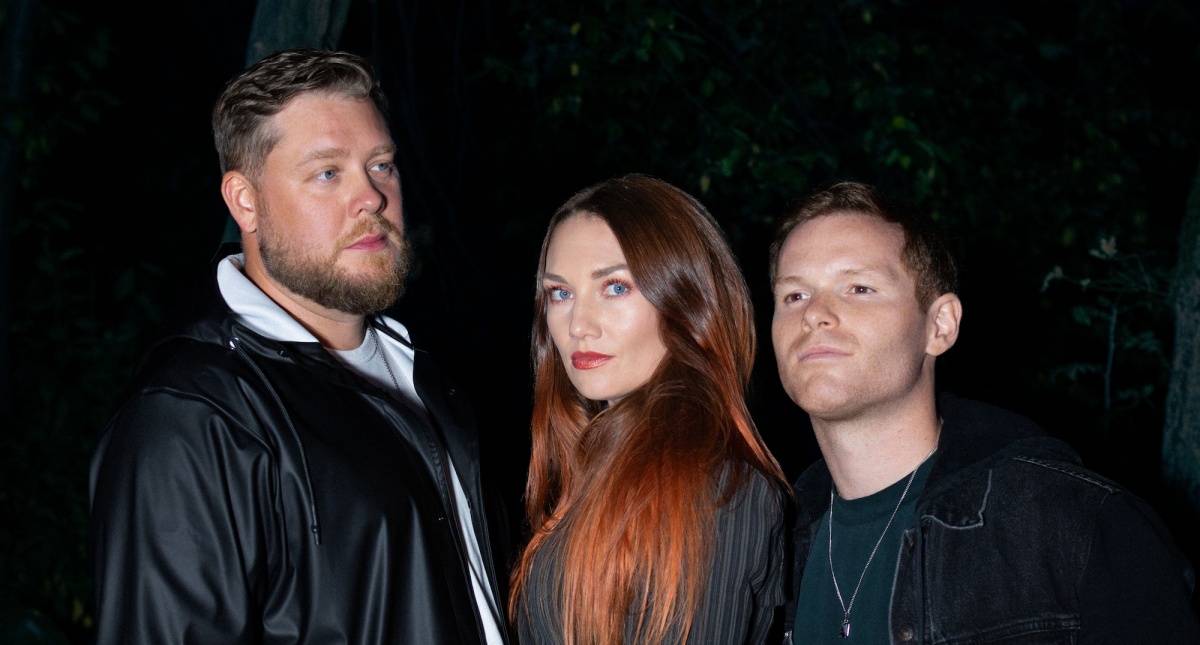
ANDØLD brings together three artists whose work has taken them through different corners of music. Belgian-Dutch producer Harold van Lennep has released on Armada and Universal, with his track “Liberation” passing 150 million streams. Swedish artist and songwriter Matilda Thompson has written for acts including Pitbull, Becky G and Red Velvet, while Stockholm producer Andreas Ahrnberg’s credits span K-pop, Swedish Eurovision and Netflix.
The three first met at a writing session in Amsterdam in 2018. Little came of the music that day, but they kept in touch, and later sessions in Bruges and Tuscany gave ANDØLD its shape. Their new single Dive now marks the launch of their own label, ØBSCURE RECORDS.
We spoke to them about the years between that first meeting and the label’s debut, how three distinct backgrounds feed into one project, and the studio moments they couldn’t have planned.
You each come from quite different musical backgrounds, from electronic music and pop songwriting to R&B and hip-hop. Which influences from outside house music tend to find their way into ANDØLD most often?
Probably the pop songwriting instinct more than anything. Even when we’re making something that is clearly electronic, the arrangement and melodic dynamic are always very present. There are definitely traces of R&B and hip-hop in the way we approach rhythm and production too, but our pop background comes through the most in ANDØLD.
When you start a new ANDØLD track, what usually comes first? Is there typically a melody, vocal idea or production concept that gives everyone something to build around?
It differs a lot, but we like to show each other recent ideas and see if there’s something we can shape into an ANDØLD track. We’ve joked before that it’s a little like crate digging in our own basement.
With our third single, Harold brought in a track and we ended up stripping it down so much that only the bass was left – much to his disappointment, haha. But that bass alone had so much ID, and that’s usually what we’re looking for first. Once we find that, there’s this excitement and energy in the room that gives us something to build around and eventually turn into something we all really love.

There’s a strong contrast in your music between melancholy and more uplifting, euphoric moments. How much of that comes naturally from the writing, and how much do you consciously shape through the production?
A lot of the melancholy comes very naturally. I mean, two of us are practically from the North Pole. We’re all drawn to melodies and chords that have some kind of emotional tension in them, so we don’t really have to force that side of ANDØLD.
The contrast is where the production becomes more conscious. With Dive, for example, we wanted the verses to leave enough space for the vocal and the emotion of the song, and then gradually build and release that tension. The topline usually leads the way, and we shape the production around where we feel it needs to breathe or hit harder.
With three people involved in the production and songwriting process, how do you decide when an idea is worth pursuing? Do you generally agree quickly, or are the best tracks sometimes the ones you have to convince each other about?
We’ll probably run into a lot of discussions down the road, but so far it’s been incredibly seamless. We tend to agree on a lot while still pushing each other further. We never settle too quickly, and usually we all know when a topline isn’t fully there yet or the production needs more work. Sometimes one person believes in an idea a little more and has to persuade the others to see it through, but overall we’re almost always aligned.
Andreas has spoken about pushing ideas until they become something unexpected. Can you give us an example of a track or sound that changed significantly during the process because somebody decided to take it in another direction?
When Matilda and Marlene were writing one of the first songs, they had a few lines and just sang them together in the room. Harold and Andreas had such a strong reaction to the way their voices sounded together that we decided to record them in unison, singing into the same mic at the same time to almost create a new voice. That spontaneous little moment ended up becoming one of the key sounds across our first three singles.
Stuff like that, or production slips like accidentally cutting off a synth so it only plays up to around 600 Hz, then realizing we had to go with it and change the drums around it. It’s those little mistakes or compromises that sometimes end up leading us to something good.
Your music combines electronic production with quite a strong pop songwriting instinct. How do you keep the immediacy of a song while still leaving enough room for the longer builds and repetition that work in house music?
The songs are short for a DJ set but long for a radio edit, so I think we’ve ended up somewhere in between. We usually skip the middle 8 and a third chorus, which hopefully gives the listener a reason to just play it again, haha.
But a lot of it is also about deciding where the song actually needs to move forward and where repetition can do the work. Coming from pop, we’re used to introducing something new every few bars, whereas in house music you can let a melody or vocal phrase sit for longer and build tension around it. We try not to add things just for the sake of it. If the topline is strong enough, sometimes repeating one line while the production slowly changes underneath it can be more effective than writing another section.
You’ve spent years working in professional studios and writing camps. Are there any production habits, pieces of equipment or studio rules that have become essential when the three of you work together?
Since we were friends before we started working, we’ve never really treated our time as traditional sessions. Harold lives in the UK and the other two of us are in Sweden, so when we meet it’s usually for a few days at a time, often at someone’s country house or somewhere we can just hang out, cook, talk shit and eventually end up writing.
We never really start the day with “we have to finish this today” or force ourselves into the studio at a certain time. The writing is usually just part of everything else that’s going on, and somehow that seems to work really well for us. We’re not too precious about the setup either, give us a piano and an SM7B and we’re good to go. Once it’s time to properly finish the production and get a track ready for mix though, we usually end up back in our proper studio.
You’ve described ANDØLD as drawing on a darker Nordic melodic sensibility. What does that actually mean to you musically, and are there particular artists, records or experiences that helped shape that side of the project?
The Swedish melancholy is definitely part of it. It’s kind of omnipresent here in the music, the seasons, the darkness and the amount of space around you. ANDØLD wouldn’t sound the same if we were making it in sunny Miami. There’s something about that stillness that we embrace rather than resist, and music becomes an outlet for it.
At the same time, our sound really started to take shape during that one session at a camp we hosted in Bruges. The stars kind of aligned, the right people were in the room and things just clicked. Musically, that Nordic sensibility shows up mostly in the chords and melodies. We like that slight tension where something can feel melancholic and euphoric at the same time, and then use the production to push that contrast even further.
DIVE is out now