


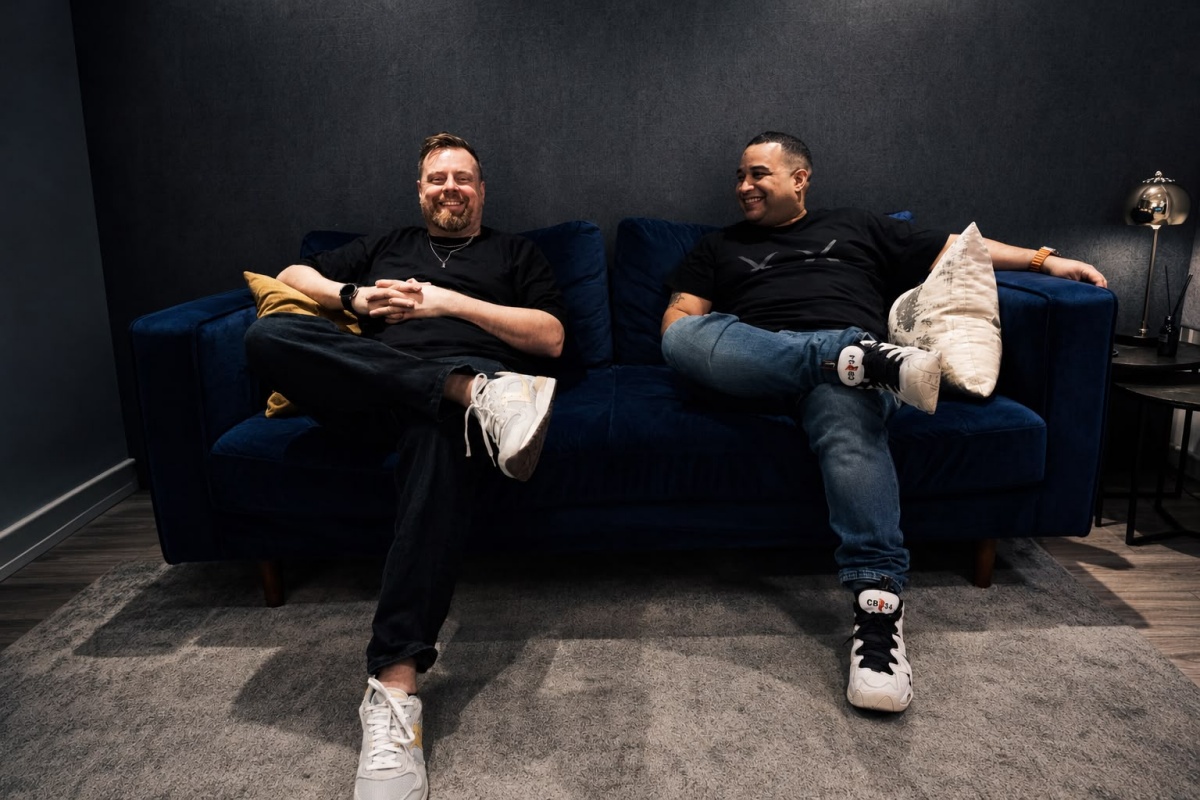
UK duo Trilucid have spent the past few years steadily expanding the scope of their progressive and melodic sound, with releases across Anjunadeep Explorations, UV and their own Ionica Audio imprint. Recent records including Let Go Of Your Pain, Too Good and the Phil Martyn collaboration Atlas have shown different sides of the project, moving between deeper, atmospheric material and more driving club music.
On 26 September, they head to London’s 93 Feet East for an extended set as part of MIOAZ’s first birthday, joining Braxton and a line-up built around the emerging artists and deeper progressive sounds the platform has championed throughout its first year. The longer format is central to the night’s ethos, giving Trilucid the space to stretch beyond the obvious peaks and explore the different strands of their sound.
Ahead of the party, Find Your Sounds caught up with Trilucid to talk extended sets, the changing shape of club culture, building Ionica Audio, their relationship with MIOAZ and what comes next.
You’re playing an extended set for MIOAZ’s first birthday, and that format feels particularly suited to Trilucid. When you know you have significantly more room than in a usual club set, what becomes possible? Do you arrive with a sense of the journey you want to create, or is the appeal precisely that you can read the room and end up somewhere you had not planned?
The extra time gives us room to breathe. We do not have to prove everything in the first ten minutes or throw every big idea at the room straight away. We can let the night unfold properly: begin with atmosphere, find the groove, establish trust with the crowd, and then gradually open things up.
We always arrive prepared. We have a good idea of the records we want to play and the different directions the set could take, but we never want to programme the whole thing in advance. The room has to have a say. Sometimes the crowd wants to go deeper and more hypnotic; sometimes you can feel that they are ready for something more driving. One record can completely change the temperature, and suddenly the route you imagined is no longer the route you want to take.
That is where an extended set really suits Trilucid. We can show more of the project than just its obvious peaks. There is space for deeper progressive material, melodic records, atmospheric passages and tougher club tracks, and we can connect those worlds rather than treating them as separate boxes. For us, the journey matters as much as the destination.
MIOAZ talks a lot about resisting the tendency towards increasingly short DJ sets and giving artists enough time to properly develop an idea. You have both been around club culture long enough to see how dramatically the way people consume dance music has changed. Do you think something has been lost as DJ sets have become shorter and more immediately focused, and what do you personally want from a night when you are on the other side of the booth?
Something has definitely been lost. Short sets can be exciting, and there is a real skill in making an impact quickly, but when everything is compressed, there can be pressure for every track to be a moment. That is very different from the club culture we fell in love with, where a DJ could spend an hour getting the room into the right headspace before really opening things up.
For us, the magic is in the gradual stuff. A bassline that seems understated at first can suddenly feel huge because the room has been sitting with it. A transition nobody would notice on a playlist can completely change the energy when you are standing in a dark room with a few hundred people. Some records need time to reveal themselves, and some of the best moments happen when you are not trying to manufacture a big moment at all.
From the other side of the booth, we want to feel that the DJ is listening. We want them to build rather than simply unload their biggest records: warm the room, create tension, take a left turn, hold something back, then give it to people when they are ready. A great set should feel like a story that could only have happened in that room, on that night, rather than a playlist of highlights.

ticket here : https://ra.co/events/2431090
There is a natural overlap between Trilucid and what MIOAZ is trying to build around the deeper end of progressive and melodic music, but that territory has also become incredibly broad. Your recent records move from Let Go Of Your Pain and Too Good on Anjunadeep Explorations through to Atlas with Phil Martyn and the more driving material on UV. Where do you feel Trilucid sits within that landscape now, and has your idea of what a Trilucid record can be widened over the last couple of years?
Trilucid has always lived in the space where progressive, melodic, deep and organic music overlap, but the important distinction for us is that emotion and dancefloor function have to coexist. We love records that create a feeling, but we are not interested in making something that only works beautifully through headphones. There needs to be movement in it. You should be able to feel the low end in a room while still having something melodic or emotional pulling you through it.
The recent releases have definitely widened the palette. Let Go Of Your Pain and Too Good brought a more vulnerable, melodic side of Trilucid to the surface, whereas Atlas with Phil Martyn and some of the UV material lean further into driving progressive territory. They are different expressions of the same project rather than attempts to reinvent ourselves for each label.
Ionica Audio has been important in that respect too. Having our own label means we can follow an idea without first asking where it fits in somebody else’s catalogue. We can put out something deeper, stranger, more club-focused or more experimental if it feels right for the Trilucid world.
So we would not describe ourselves as trying to occupy one narrow genre. The thread is more about feeling and function: melody, atmosphere, groove, detail and progression. If a record has emotional weight but still makes sense when the lights go down and the system comes on, that is where Trilucid feels most at home.
You have spoken before about Hilton bringing more of the DJ perspective into the studio while Andy can disappear much further into sound design and production. Does that same division exist when you are preparing for a long set together? Who is more likely to push things somewhere unexpected, and where do your tastes still genuinely differ?
That division definitely exists. We naturally think about the room first. We listen for the physical side of a track: where the kick sits, how the bass will translate on a big system, whether the groove will make people move, where it could sit in a set and what kind of energy it creates.
Andy can disappear down the rabbit hole of the production itself. He will hear a tiny texture, a sound buried in the arrangement or a harmonic detail, and suddenly we are talking about something we had not even consciously noticed. He is very good at asking whether a track can be made more interesting rather than simply more functional.
That difference is useful when we are preparing a long set. One of us might be thinking, “This needs to push now,” while Andy is thinking, “Actually, give this another four minutes and let the atmosphere do the work.” Or one of us might want something more direct, and Andy will find a way to make it stranger without losing the groove.
We do not always agree immediately, and that is healthy. Trilucid works because there are two perspectives constantly pulling against each other: the DJs thinking about the room and the producer thinking about the detail. The best ideas usually happen somewhere in the middle.
MIOAZ is only a year old and is now moving from events into running its own labels, with a particular emphasis on giving developing artists somewhere to grow. You have gone through that process yourselves with Ionica Audio, which is now becoming a substantial part of the wider Trilucid world. What have you learned from building a label alongside an artist career, and what advice would you give MIOAZ as it starts trying to establish an identity beyond the parties?
Building Ionica Audio has taught us that a label needs a reason to exist beyond putting music on Beatport. It needs a point of view. The artwork can look great and the release schedule can be consistent, but if there is no feeling behind it, people will not build an emotional connection with it.
For us, Ionica Audio is an extension of the Trilucid world, but it is not simply a vehicle for our own records. It gives us somewhere to champion artists we believe in, explore music that might not fit elsewhere, develop the Ionica Sessions radio show and create a community around the sound. That is a very different role from being artists releasing on somebody else’s label. We suddenly care about the whole ecosystem, not just our own track.
There is also a lot of invisible work involved. A label means deadlines, metadata, artwork, mastering, distribution, promotion, emails and a lot of spreadsheets that nobody listening to the record will ever see. But when all those pieces start to feel coherent, it becomes incredibly rewarding.
For MIOAZ, we would say: do not lose the personality that made the parties work in the first place. The label should feel like an extension of that room. If people trust MIOAZ because they know they will hear thoughtful progressive and melodic music from artists who have been given proper space, that trust can carry into the releases. There is no need to rush into becoming a huge label. Build something people recognise by feel.
One interesting thing about the MIOAZ line-up is that Trilucid and Braxton are the established names, but there is deliberately a lot of space given to London artists who are still developing, including two DJs selected through MIOAZ’s recent search. Thinking back to the period when you were trying to establish yourselves, how important were smaller promoters, residencies and communities in actually giving you somewhere to develop as DJs rather than simply somewhere to play?
They were absolutely crucial. You do not really learn to DJ from having a good collection of music or playing the occasional big slot. You learn by being in rooms repeatedly: sometimes with twenty people, sometimes with a packed dancefloor, sometimes at 2am when the energy is completely different from what you expected, and figuring out how to respond.
We spent years playing different rooms, time slots and crowds, and every one of those experiences taught us something. Our Gallery residency at Ministry of Sound was a huge part of that. We learned how to warm up without killing the room, how to hold back when we had a big record we were desperate to play, how to recover when a transition or idea did not land, and how to recognise what people needed rather than simply playing what we personally wanted to hear.
That is why the MIOAZ approach really resonates with us. The emerging DJs on this line-up are not just there to fill a slot around the established names. They are being given a proper environment in which to develop their identities. That matters.
Scenes are built through those opportunities. Established artists can bring people through the door, but the next generation needs somewhere to experiment, make mistakes, find its sound and eventually become the artists people come to see. Smaller promoters and communities are often where that actually happens.
You have already had a busy 2026, including your Anjunadeep Explorations debut, Too Good, Atlas with Phil Martyn and plenty happening around Ionica Audio. Rather than us trying to guess what comes next, what are you working on at the moment that you are particularly excited about, whether that is new Trilucid music, collaborations, the label or something entirely outside the project?
There is a lot happening, but the main thing we are trying to do now is make the different sides of Trilucid feel like one connected world. The music is obviously at the centre, but around it you have Ionica Audio, Ionica Sessions, the live shows, the visual side and the artists we are bringing into the label.
There is new Trilucid music coming, and we are continuing to work on collaborations as well. We are enjoying having the freedom to move between the more emotional, melodic side of the project and the deeper, more driving club material without feeling that we have to choose one identity and stick to it.
Ionica Audio is a big focus too. With the label, the question is not simply, “Is this a good track?” It is, “Does this add something to the world we are building?” That is a different way of listening to music. We are thinking about the artist, the release around it, the artwork, the story and how it sits alongside everything else.
Ionica Sessions is another important piece. It gives us a weekly space to share music we are genuinely excited about, including records that might never become Trilucid releases. That distinction matters: the radio show is about curation and discovery, the label is about building a catalogue and community, and Trilucid itself is where Andy and I put our own musical identity at the centre.
We have achieved a lot over the years, but we have probably been too comfortable doing things behind the scenes. Now we want people to see more of the complete picture: the records, the DJ sets, the label, the radio, the visuals and the community around it.
Finally, 93 Feet East is a relatively intimate setting for an extended Trilucid set, and MIOAZ is treating this first birthday as a marker between its first year and what comes next. If we meet again at their second birthday in another twelve months, where would you like both Trilucid and this particular community around progressive and melodic music to have moved by then?
For Trilucid, we would like to feel more defined without becoming more restricted. We want more great music, stronger shows, more confidence in our own instincts and a clearer connection between everything we do. We want someone to hear a record, see a Trilucid set, listen to Ionica Sessions or come across an Ionica Audio release and feel that there is a common thread running through all of it.
We also want to keep developing as DJs. That is important to us. Records are one part of Trilucid, but the DJ set is where all those influences collide in real time. We can take a track we made, put it next to something completely unexpected, stretch the energy for twenty minutes and create something that does not exist anywhere outside that room. We never want to lose that side of the project.
For MIOAZ, we hope it becomes one of those London nights people genuinely trust. Not necessarily the biggest night in the city, but one where people know the music will be considered, the artists will be given enough time to play properly, and the crowd will be there because they care about the experience rather than simply the name on the flyer.
We also hope the community around progressive and melodic music becomes more connected rather than more fragmented. There are so many talented producers and DJs working in this space, and there is a real opportunity for smaller platforms to give them a proper home.
When we get to the second birthday, we would love to look back and feel that both Trilucid and MIOAZ have grown substantially, but that neither has lost its character. Bigger is not automatically better. If the music is stronger, the rooms are better, the artists are being supported and the people in front of the booth still feel that sense of discovery, then that is meaningful growth.
ticket link: https://ra.co/events/2431090